
Best Dog Food for Small Breeds: Precision Nutrition for Tiny Bodies That Demand Greatness
They weigh less than a backpack, but their metabolism burns like a reactor. Your small-breed dog isn’t a scaled-down version of a Labrador; they’re a one-of-a-kind biological engine that demands nutrition as concentrated and precise as a Swiss watch. Choosing the best dog food for small breeds isn’t a cosmetic luxury—it’s the difference between a vibrant companion and one stuck on a blood sugar rollercoaster, battling tartar buildup and anxiety. Best dog food for small breeds quality understands their accelerated rhythms, their delicate jaws, and their tiny stomachs, turning every mini-kibble into a concentrated shot of health.
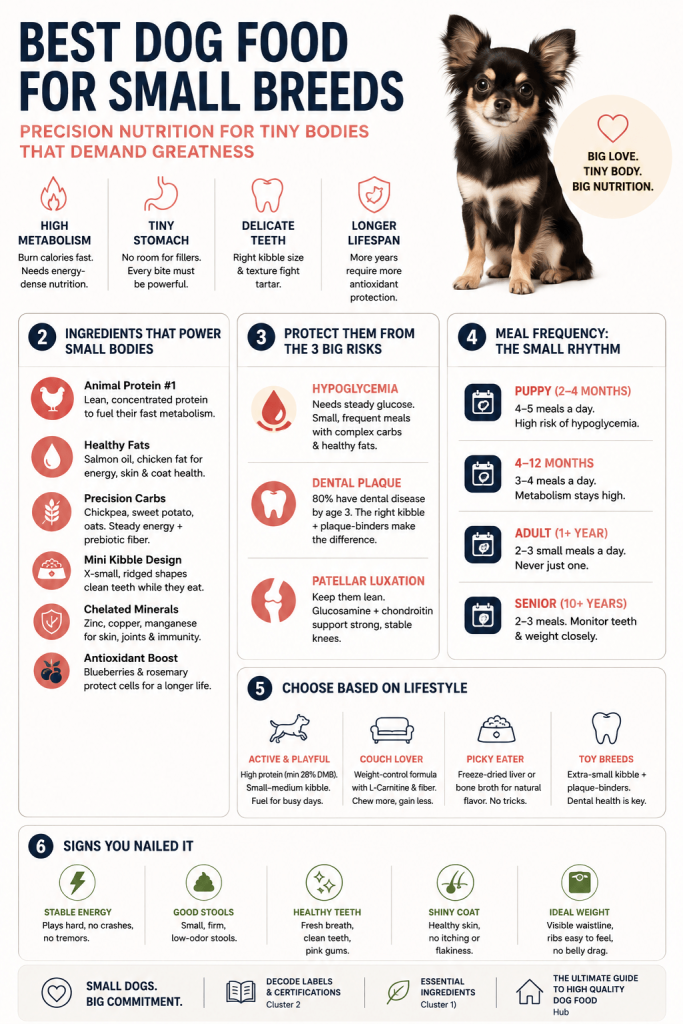
1. The High-Rev Engine: Why a Small Breed Should Never Eat Generic Kibble
Your Chihuahua, Toy Poodle, Pomeranian, or French Bulldog operates under metabolic rules opposite to those of a big dog. The best dog food for small breeds answers these relentless demands.
Metabolism on permanent overdrive: They burn calories by the minute at a dizzying pace. A fast of just a few hours can crash their blood glucose (hypoglycemia), causing tremors, lethargy, and even collapse. The best dog food for small breeds is ultra-energy-dense to steer clear of that cliff.
Microscopic stomach: Their gastric capacity is tiny. There’s no room for fillers. Every gram of kibble must be a nutritional bomb, not air or by-products.
Delicate jaws and teeth: Crowded teeth in a small mouth are a magnet for tartar. Kibble designed with a specific size, texture, and shape acts as a mechanical toothbrush, while ingredients like sodium tripolyphosphate bind calcium in saliva and reduce plaque.
Extended lifespan: Many small breeds live 15 years or more. That means prolonged exposure to oxidative stress. The best quality includes a lifetime supply of antioxidants to armor cells and organs.
2. The Small Body Table: Ingredients That Define the Best Food for Small Breeds
Identifying best dog food for small breeds quality means memorizing this list of nutritional allies that work on a millimeter scale.
| Precision Ingredient | How It Powers Your Dog's Compact Body |
|---|---|
| Concentrated animal protein (chicken, turkey, lamb, egg) as the #1 ingredient | Lean, dense muscle without bulk. Sustains their high metabolic rate without overloading a tiny stomach. |
| Named healthy fats (salmon oil, chicken fat) | Concentrated energy and essential fatty acids that nourish often-sensitive skin and a silky coat. They combat the dryness typical of small breeds. |
| Precision carbs (chickpea, sweet potato, whole oats) | Slow-release energy that prevents glucose spikes. Prebiotic fiber that stabilizes a sometimes-finicky gut flora. |
| Mini or specifically shaped kibble (X-small, ridged Y-shape) | Mechanical chewing that scrapes away plaque. The abrasive texture cleans teeth while they eat. Dental health built into every bite. |
| Chelated zinc, copper, and manganese | Instant absorption. They armor the skin, reinforce paw pads, and keep small-but-highly-active joints (knees, kneecaps) safe from luxations. |
| Blueberries and rosemary | Antioxidants that prolong cellular youth in dogs that live for many years. |
3. The Silent Enemy: Hypoglycemia, Dental Plaque, and Patellar Luxation
The best dog food for small breeds doesn’t just nourish—it prevents the three great plagues of these little dogs.
Hypoglycemia (low blood sugar): Small, frequent meals with complex carbs (not simple sugars) and sufficient fat keep blood glucose stable. A small dog fed twice a day on generic adult kibble is a potential emergency waiting to happen.
Periodontal disease: Over 80% of small dogs have dental disease by age 3. The best dog food for small breeds kibble is large for their mouth and abrasive, forcing them to chew. Some formulas include sodium tripolyphosphate to chemically fight plaque.
Patellar luxation (slipping kneecap): Excess weight is devastating on already-predisposed joints. Controlled caloric density and chondroprotectants like glucosamine and chondroitin (even in small breeds) help keep the kneecap in place.
4. Meal Frequency: The Small Rhythm That Sustains Giant Energy
With the best dog food for small breeds, when you feed is almost as important as what you feed.
Small-breed puppies (2-4 months): 4-5 meals a day. Their risk of hypoglycemia is at its peak. They cannot fast overnight without a small late-night snack.
4 to 12 months: 3-4 meals. Their stomach grows a little, but their metabolism remains a furnace.
Adults (1 year and older): A minimum of 2 meals, ideally 3 small ones. Never a single daily meal. Gastric volume won’t allow it, and the risk of bilious vomiting from prolonged fasting skyrockets.
Small-breed seniors (10-12 years and up): They can continue with 2-3 meals, keeping a close eye on dental health (switch to a senior mini kibble if needed) and any tendency to gain weight after spaying or neutering.
5. The Best Food for Small Breeds Based on Lifestyle
Not all small dogs are the same. Best dog food for small breeds quality adapts to real life.
The active city dog (walks 1-2 hours a day, plays hard): A standard small-breed maintenance formula, rich in protein (minimum 28% DMB), with small-to-medium kibble pieces.
The couch-lover (prone to weight gain; French Bulldog, Pug, Boston Terrier): A light or weight-control formula, with L-Carnitine and satiating fiber. A kibble that forces them to chew more slowly.
The picky eater: The best quality includes freeze-dried liver or dehydrated bone broth as a natural palatability enhancer. Zero chemical tricks—just real flavor that awakens their instincts.
Toy breeds with very crowded teeth (Yorkie, Chihuahua): Extra-small kibble and a formula enriched with plaque-binders. Dental health is non-negotiable.
6. Signs That You Nailed It with the Best Food for Small Breeds
Your dog tells you without words. The best dog food for small breeds is confirmed by these daily indicators.
Explosive but stable energy: Your dog jumps, plays, follows you around. No spikes and crashes, no tremors or lethargy between meals.
Mini, firm, low-odor stools: High digestibility. Their small intestine absorbs nearly everything. No mountains of soft stool.
Fresh breath and clean teeth: Tartar doesn’t advance, gums are pink—not red. Your vet is surprised at every checkup.
Shiny coat, flake-free and itch-free skin: The right fats and chelated zinc soothe sensitive skin. Less paw licking, less redness.
Stable weight and a visible waistline: From above, you see their hourglass silhouette. Ribs are easy to feel. No dragging belly.
Conclusion: Small Demands Maximum Nutritional Greatness
Choosing the best dog food for small breeds is honoring the most fascinating biological engineering in the canine world. Their hearts beat fast, their tiny paws never stop, and their eyes follow you everywhere. By giving them best dog food for small breeds quality, you’re filling that little body with years, vitality, and boundless walks together.
Keep sharpening your expert pet parent eye:
Learn to decode any label and certification: How to Identify Best Quality Dog Food Labels
Discover the ingredients that turn a meal into a health shield: Dog Food Ingredients
Return to your nutritional knowledge hub: The Ultimate Guide to High Quality Dog Food
Facebook
Pinterest
X
Email
